
Tree Inspection Technologies

Laser deflectometer for trees

Measurement technology for pulling tests and wind response measurements.

LOFOR® – the first laser-based deflectometer for tree load testing

Advantages

New: precise determination of the bending line

The LOFOR laser deflectometer captures trunk bending under load as the integral response of all structurally relevant properties. The measured deformation reflects the sum of all contributing factors: wood type variations such as heartwood, reaction wood and sapwood, the actual cross-section, and existing defects such as cavities, decay and cracks.

Pulling tests and wind response measurements with minimal hardware effort

Stable readings at low force levels. In certain situations, manual force (300–400 N) is sufficient.

For force measurement during pulling tests, the LOFOR-compatible lineScale3 load cell is recommended.

High resolution with less force

Measurement results with virtually unlimited accuracy. Through optical signal amplification, the smallest movements can be detected – ideal for trees with large diameters. 

Thanks to the low force required, habitat tree torsos and trees with graft unions can also be tested.

Dynamic wind response

Individual wind gusts (from approximately 40 km/h) are already sufficient to measure the bending line and root plate inclination – under dynamic wind conditions.

Data export to Arbostat

Arbostat files can be read and written: laser angles are inserted as inclino values.

Distinguish and identify failure patterns early

LOFOR measurement reveals where and how the trunk bends or twists (torsion around the trunk axis). Root damage manifests as the tree rotating in the ground – with little trunk bending. 

Flexible, scalable precision

Sensitivity increases with the distance between lasers and projection surface. Clear line of sight is required; vegetation or infrastructure may obstruct the measurement. 

How it works

Simple setup – complex results

01

Capture geometry & mount lasers

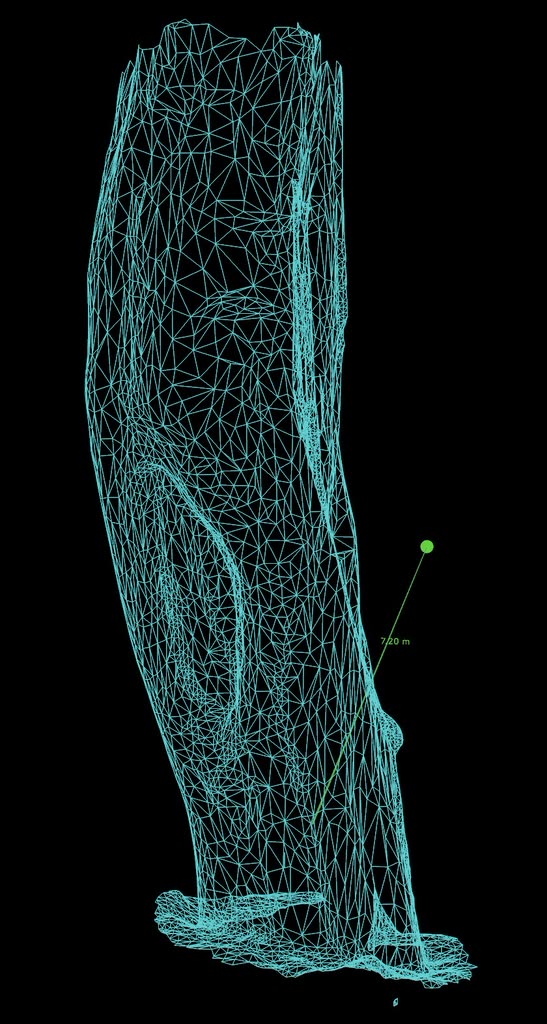
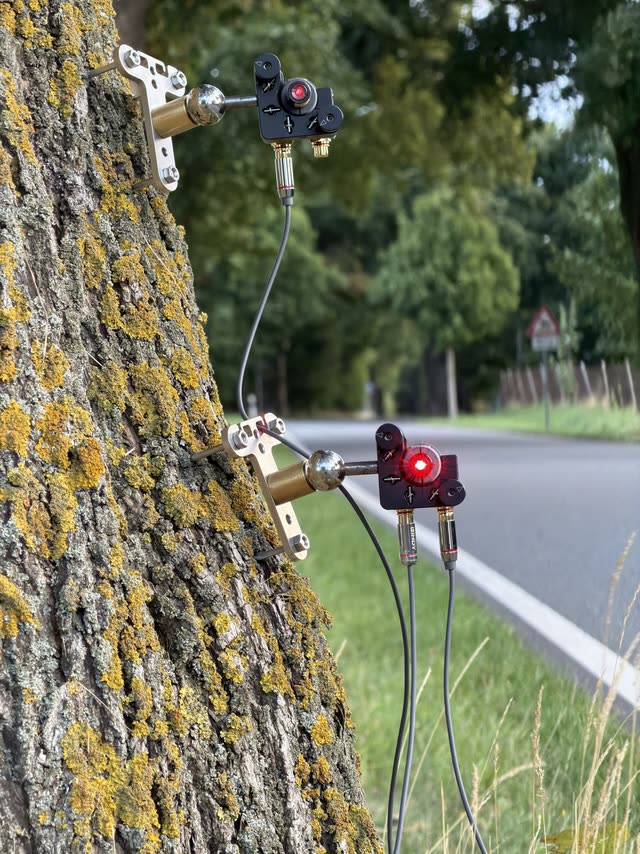
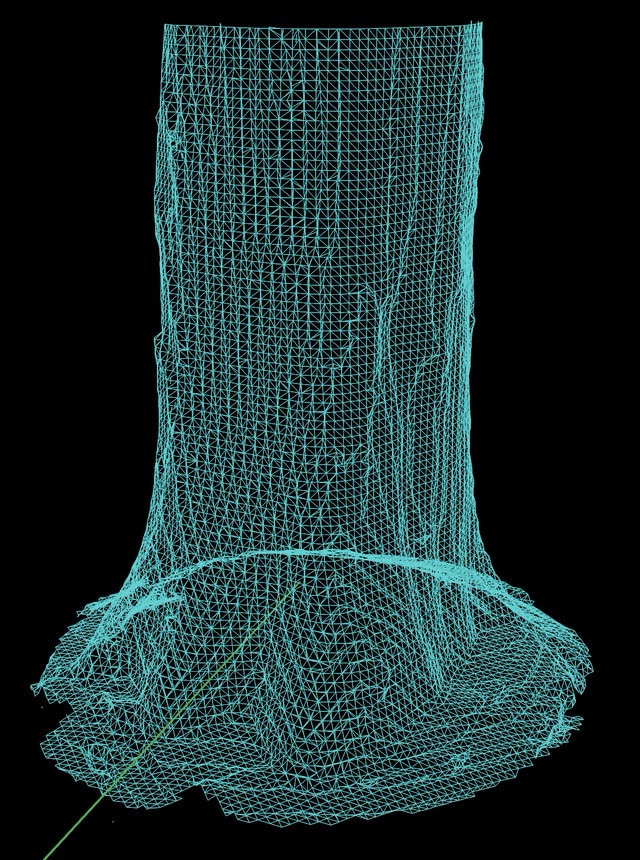
Record the trunk geometry using the LOFOR app (LiDAR scan). Then mount the lasers along the trunk axis and align them so that the beams strike the projection surface. 

Screenshot der LOFOR® App mit LiDAR-Scan eines Baumstamms als 3D-Modell

02

Perform measurement

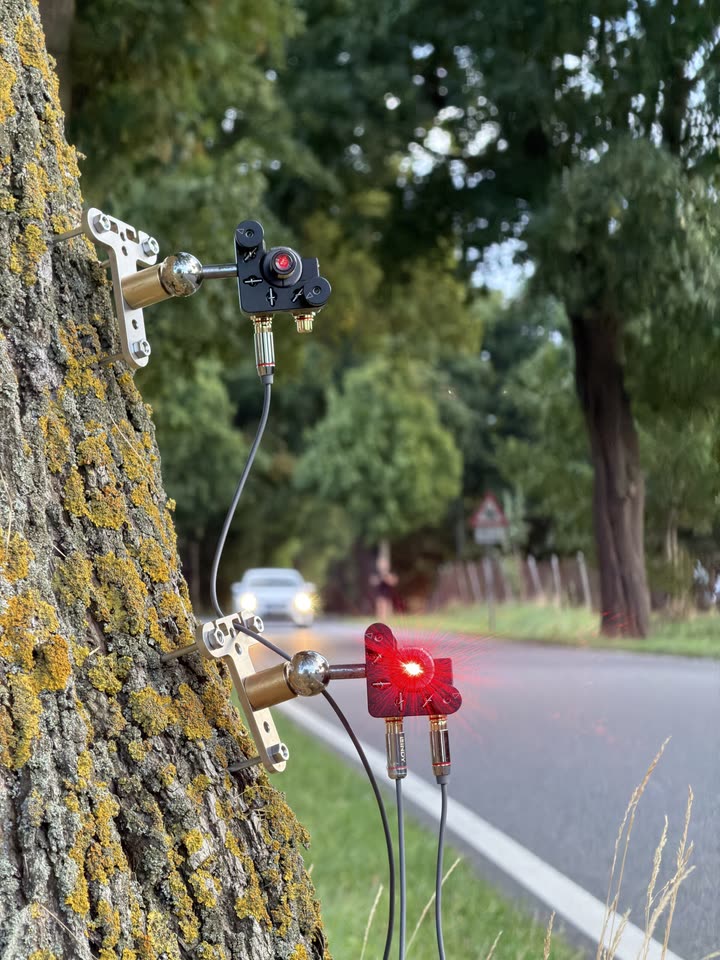
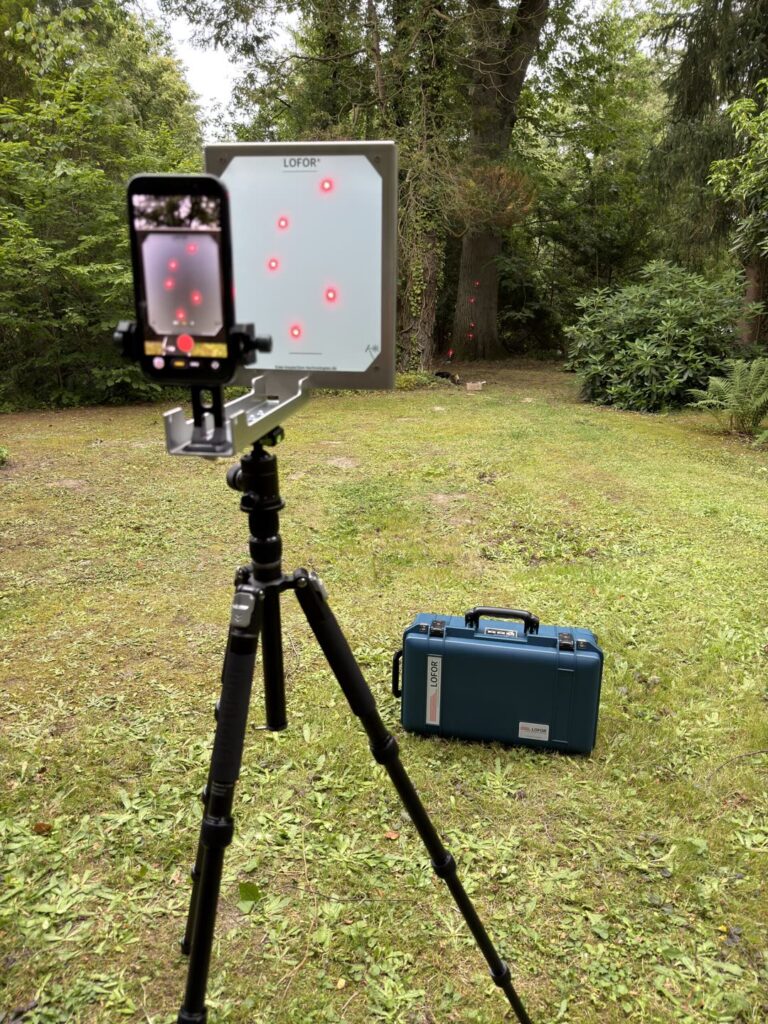
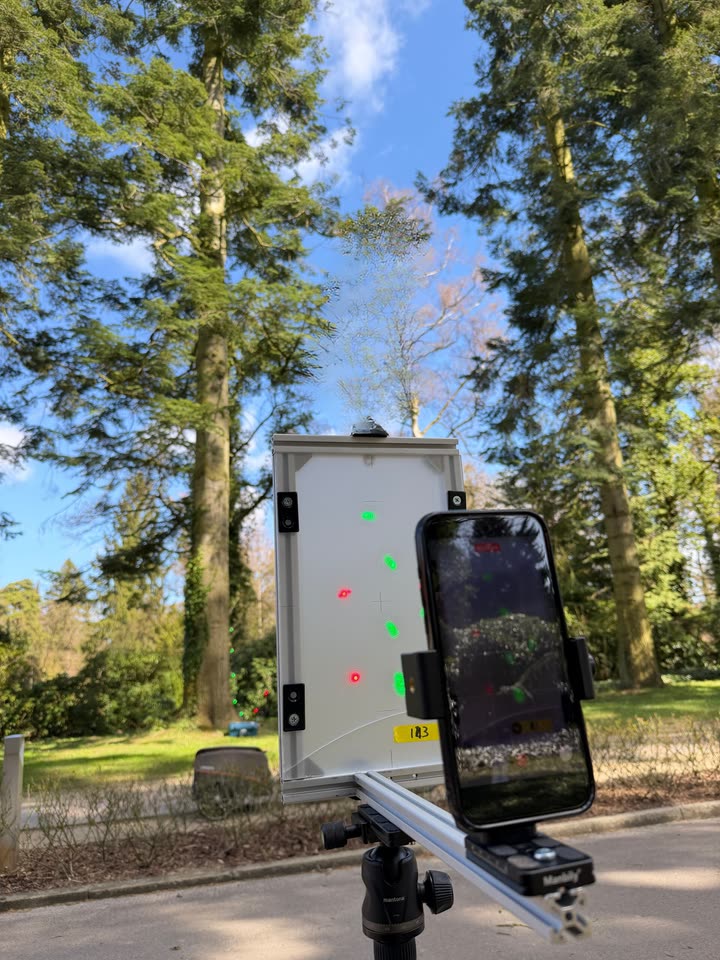
Apply a load or wait for wind gusts. The camera films the movement of the laser dots on the projection surface. This movement corresponds to the angles of the trunk.

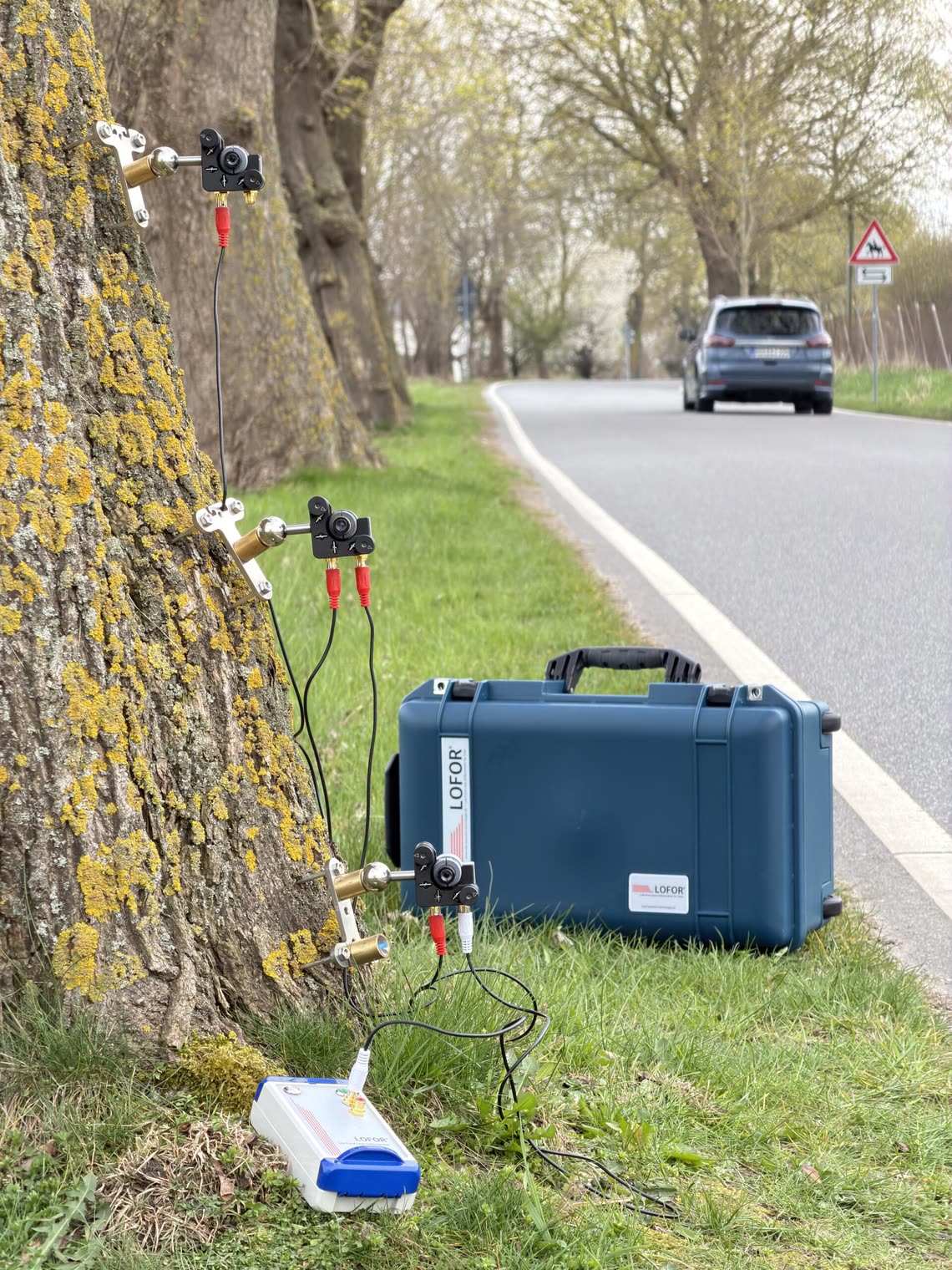
LOFOR® Laser-Deflektometer bei der Messung an einem Straßenbaum

03

View results

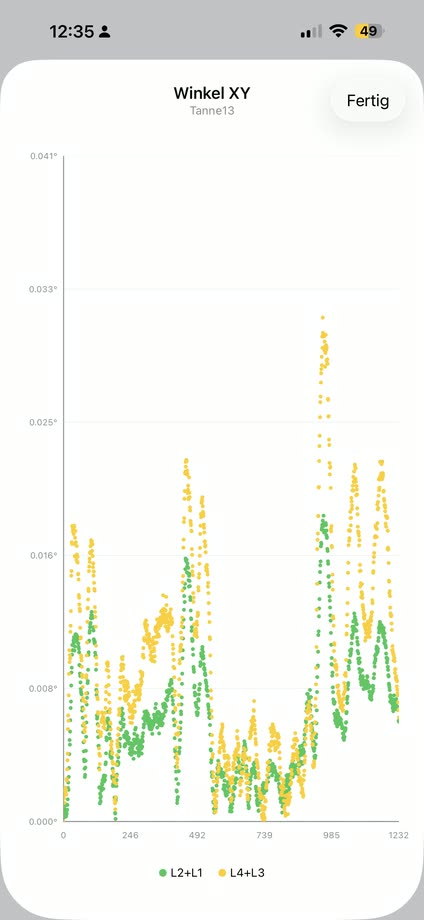
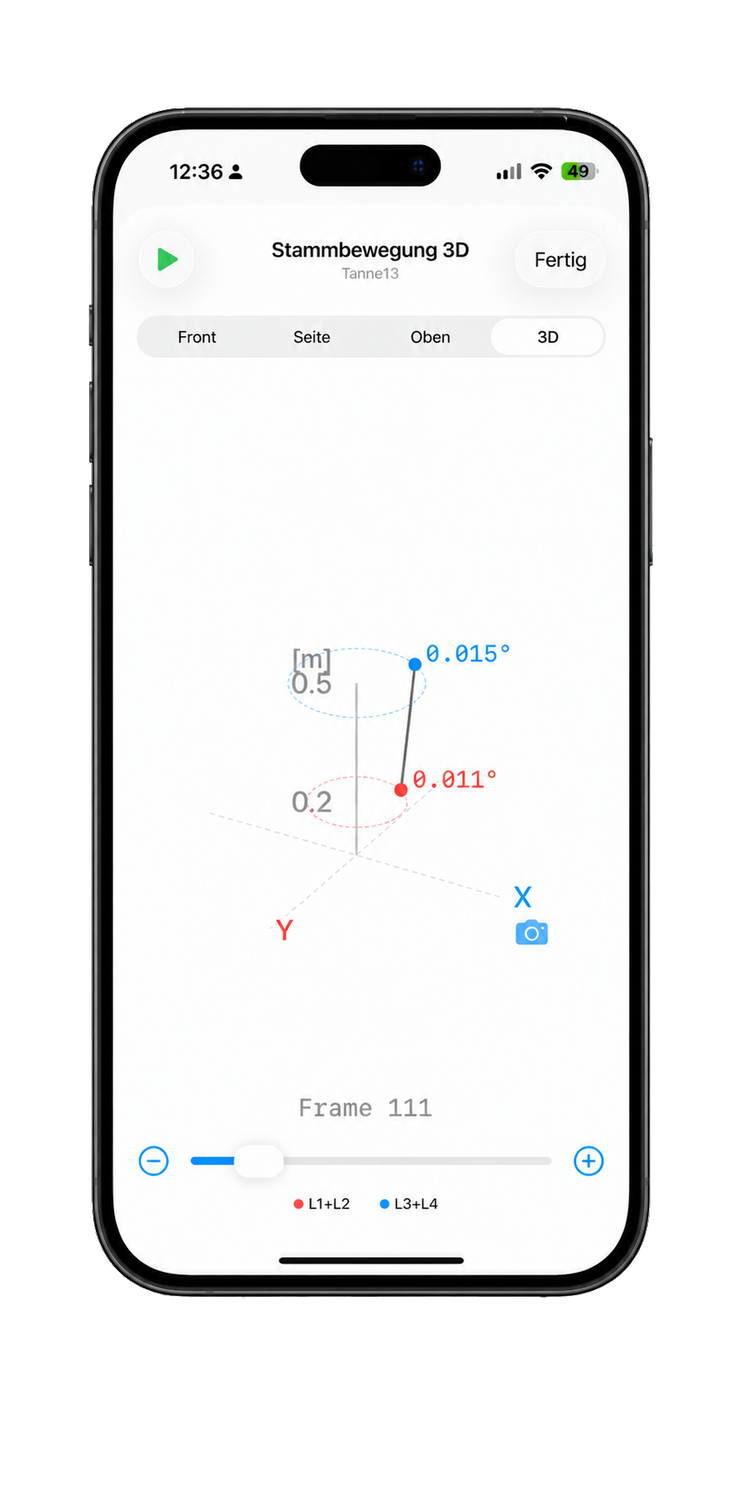
The LOFOR app displays the bending line and the bending at the stem base. Various charts support the assessment. Data can be exported to Arbostat.

Interactive demo

Tree deflection under wind load

Move the slider to play measurement frames. Each point represents a laser at a different trunk height.

4 – 10+

Lasers 

< 0.001°

Resolution (depending on tree-to-camera distance)

24-240

Frames/sec – depending on video settings

2 axes

For wind measurements: second laser direction with mirror redirection 

Deflection Curve
Simulated wind response — drag slider or press play
Frame 001

In the field

Simple setup - high accuracy

LOFOR®-Messaufbau: iPhone auf Stativ filmt die Laserpunkte auf der Projektionsfläche
LOFOR®-Laser an einem Straßenbaum am Feldrand montiert LOFOR®-Laser mit Halterung am Baumstamm montiert 3D-LiDAR-Modell eines Baumstamms, erstellt mit der LOFOR® App LOFOR® im Außeneinsatz an einer Tanne mit aktiven Lasern

THE APP

All analyses. In your pocket. 

—

Trunk section angle — Bending per trunk section

—

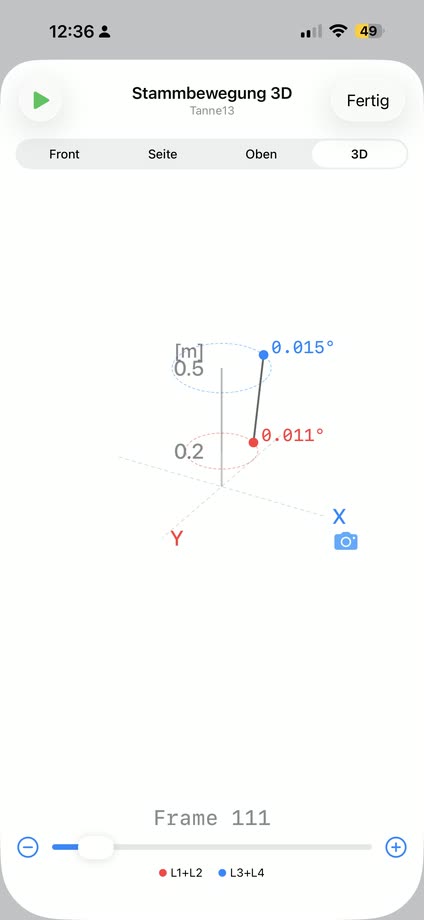
Bending line — complete dynamic load visualisation. Comparison with the theoretical bending line using the 3D trunk geometry

—

Real-time frame scrubbing: playback in real time or frame by frame
 

—

Arbostat-compatible export
 
 
LOFOR® App auf dem iPhone mit 3D-Ansicht der Stammbewegung
App-Icon der LOFOR® App für iPhone und iPad

Who is it for?

For everyone who wants to truly understand trees

Tree experts

Assessing stability along roads, in parks and on private property: how much does the trunk bend under a defined force – and are there weak points along its height?

Research & biomechanics

Investigating the mechanical behaviour of trunks under pulling and wind load – with low-noise data, fibre strain and comparison with the Euler-Bernoulli bending line.

Arborists & tree care

Quickly assessing on site whether a tree responds unusually softly to a rope pull – or analysing its behaviour in wind via video.

FAQ

Frequently asked questions about LOFOR®

Do I need a computer in addition to my iPhone or iPad?

No. All data recording and analysis runs on an iPhone or iPad – preferably a model with a LiDAR scanner. There is no need to transfer data to a Mac.

Does every iPhone and iPad work?

In principle, yes. Models with a LiDAR scanner also capture the trunk geometry, which is required for certain analyses. Larger screens make operation easier, as a lot of information is displayed simultaneously during measurement. The iPad mount on the projection surface is currently designed for 11" iPads.

How are the results exported?

Results can be exported as tabular files. Export to the Arbostat file format is available – the laser angles are transferred as inclinometer values.

How robust is the system in the field?

The hardware is deliberately simple: lasers and a power supply – fewer components, fewer things that can fail in the field. The lasers are rated for more than 3,000 operating hours. The development effort has gone mainly into field usability and the software.

What are the limitations of the method?

The laser beams need a clear line of sight between tree and projection surface; slopes, walls or vegetation can make measurement more difficult – a mirror often helps to get around low obstacles. Rain on the projection surface interferes with dot detection, and in bright sunlight it should be shaded. And: higher resolution requires more distance, which may be limited in confined urban sites.

Does LOFOR® give a “keep” or “fell” recommendation?

No. LOFOR® provides precise measurement data on deformation behaviour, not an automatic decision – strictly speaking, hardly any method can do that. LOFOR® is not a certified measuring device; its results do not replace standard-compliant testing, but can serve as a basis for expert reports.

Contact

See LOFOR® in action

Would you like to know whether LOFOR® suits your question? We are happy to advise you and show you the system in the field.

Get in touch -->

App-Icon von LoGeoS – Low Effort Geometry Scanner für die Tomographie

Also of interest

LoGeoS – Geometry Scanner

Measuring point geometry for tomography via AR scan – captured with your iPhone in just a few minutes.

Go to LoGeoS -->